
Introduction
When you envision a beautiful patio, walkway, and backyard sitting area, installing pavers on sand is one of the surest and least expensive ways. This style is adopted by homeowners, do-it-yourself people, and the most successful landscaping firms, such as Glscapes, due to its stability, versatility, and professionalism.
This all-encompassing guide will dissect the reasons why putting pavers on sand is such a good idea, the tools required, the correct type of sand, and step-by-step installation recommendations in order to have a finished outdoor space that is refined and will last many years.
Why Pavers on Sand Are the Best Installation
Installation of pavers on sand is a favourite way of landscape construction in contemporary landscaping because of several reasons:
Flexible Foundation
Sand offers a material that is flexible and does not crack upon slight movements of the ground, and so the pavers can be flexible.
Excellent Drainage
Sand enables the water to pass through rather than accumulating the water on the surface.
Affordable and simple to deal with
Sand is cheap, simple to smooth, and suited to self-assembly projects.
Good Support on Compaction
Sand, when compacted properly, forms a solid layer that holds pavers for a few years.
Glscapes believes in this approach, as it develops stable, lasting, and appealing outside environments that can resist the changes in weather and high levels of foot traffic.
Paver installation on sand: Step-by-Step Guide
The following is a breakdown of the entire process when installing pavers on sand, such as the one employed by Glscapes to install pavers on a professional level.
1. Begin With a Decently Planned Design.
Measure the project area and mark the layout with the help of stakes and string lines.
Accurate planning ensures:
- Perfect alignment
- Balanced edges
- Minimal cutting
- A clean finish
Glscapes will always make sure that the layout is calculated accurately before installing pavers on sand.
2. Excavate the Area
Excavate a hole of 5 inches to 7 inches (depending on soil type).
This depth includes:
- 3-4 inches of gravel base
- 1 inch of sand
- Paver height
Correct excavation eliminates settling and aids pavers to be in the same plane over time.
3. Throw and Compact the Gravel Base.
Pavers on sand should be installed on a solid gravel base.
Crushed rock or road base can be used and compacted using a plate compactor to remove air pockets.
This will prevent sinking, shifting, and uneven surfaces in the future.
4. Add a 1-Inch Sand Layer
This is also the most significant in laying pavers on sand.
Use the right type of sand:
- Preferably, concrete sand (coarse sand) is preferred.
- Avoid play sand, it’s too fine
Smooth the sand over, and run over it with a board to make the surface smooth and level.
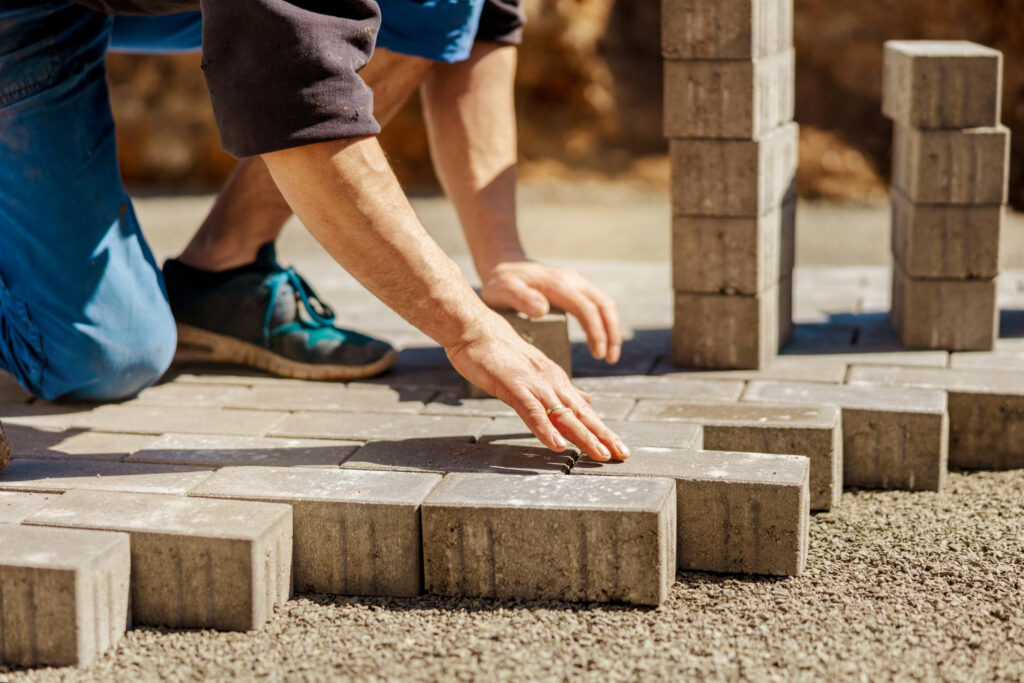
5. Lay the Pavers
Begin somewhere in a straight line, and proceed over the patio.
When you are laying paving on sand:
- Use consistent spacing
- Follow your chosen pattern
- Remember to use string lines to keep pavers in line.
Glscapes recommends one should start at a corner, to be precise.
6. Adjust manually with a Rubber Mallet.
A rubber hammer is used to be able to knock each paver into position without shattering or harming the rock.
This gives it a tight fit and smooth surface.
7. Add Edge Restraints
Edge restraints ensure that pavers do not move away.
They can be made of:
- Plastic
- Aluminium
- Concrete
The laying of pavers over sand soil without edging may cause spreading and uneven pavement.
8. Fill the Joints With Sand
When all the pavers are in place, brush polymeric sand or fine sand in the joints.
This step:
- Locks the pavers together
- Prevents weeds from growing
- Improves stability
Glscapes also applies polymeric sand because of its strong erosion resistance capability and durability.
9. Final Compaction
Dump it in the whole paved area using a plate compactor.
This pats the sand deep into the joints and firmly fixes the paver.
Your patio is finished, and it is ready to be used!
Errors to Minimise When Buying Pavers on Sand
The following are the most typical problems that individuals experience when laying pavers on sand:
- Using play sand
- Too small and cannot be compacted.
- Skipping the gravel base
- Causes sinking and uneven patio.
- Uneven sand depth
- Results in wobbling pavers.
- Not compacting enough
- Makes it prematurely shift and leave gaps.
- Not using edge restraints
- Fences will divide as time goes by.
Glscapes does not make any of these errors, as they utilize correct measurements, correct materials, and professionalism in installations.
Why choose Glscapes to have your pavers installed?
Glscapes provides outdoor landscaping transformations that are done with sophisticated methods of using pavers on sand. Their team specializes in:
- Custom patio designs
- High-precision leveling
- Professional compaction
- Clean finishing
- Long-lasting installations
All the projects are well managed to make them beautiful, functional, and long-lasting.
Conclusion
When you are planning a patio, walkway, driveway, or backyard entertainment area, then the use of sand paving is one of the best methods to use in order to get long-lasting and attractive outcomes. When you have the correct preparation, the correct tools, and the expert techniques, your paver project will stand for years.
Since this is a reliable method of installation, Glscapes still uses this method to provide the homeowners with the most stunning spaces outside their homes, and with each project, they are assured of beauty and reliability. Contact Glscapes today for more details.
FAQs
Question 1. Are pavers installed on sand long-lasting?
Ans: Yes. Sand makes up a powerful and stable base when compacted with a gravel bed.
Question 2. Which kind of sand is to be used under pavers?
Ans: Coarse concrete sand should be used this settles well and would give good drainage.
Question 3. Is it possible to put down pavers on dirt?
Ans: No. Pavers will sink and move without the gravel and sand layers.
Question 4. What is the thickness of the layer of sand?
Ans: The best thickness of pavers to be placed on sand is 1 inch.
Question 5. Is Glscapes a professional paving company?
Ans: Absolutely. Glscapes provides complete management of patio paver design and installation services of walkways, etc.